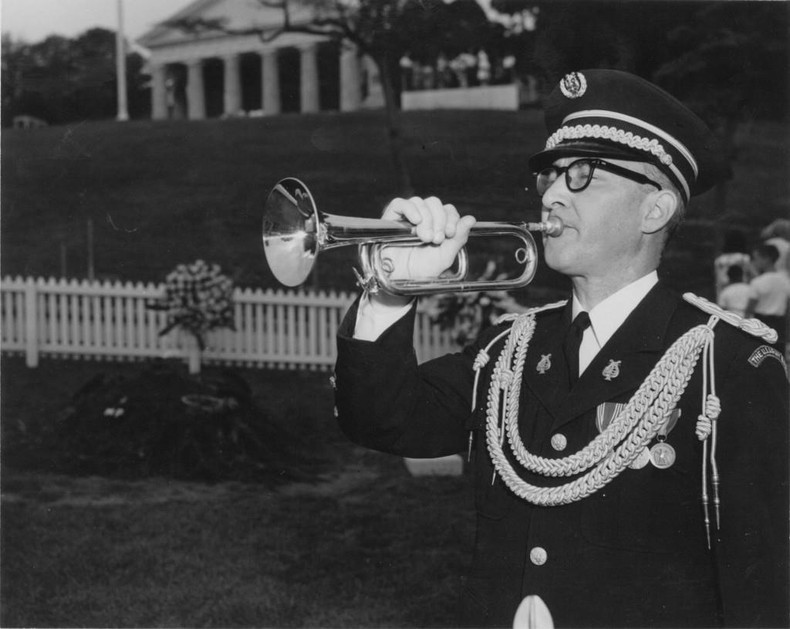
Of all of the military bugle calls, TAPS is one of the most easily recognizable and is the call more apt to render emotion. The 24 notes of Taps have been performed each day in almost every part of our nation.
Around the time of the Civil War, the traditional call at the end of the day was called “Lights Out,” which was borrowed from the French. In July of 1862, after the bloody Seven Days battles in which Union General Daniel Adams Butterfield lost many men, General Butterfield called the brigade bugler to his tent. He wanted to honor his men and considered "Lights Out" to be too formal.
Basing his new call after a bugle call named "Scotts Tattoo," General Butterfield wrote his own version. After writing notes on the back of an envelope, General Butterfield asked Oliver Wilcox Norton to sound the notes out on his bugle. After making a few minor changes, Oliver Wilcox Norton was directed to sound that call for Taps in place of the regulation call, “Lights Out.”
Taps was soon adopted throughout the military. In 1874 it was officially recognized by the U.S. Army, and it became standard at military funeral ceremonies in 1891.
The origin of the word "Taps" is said to have come from the Dutch word for "Tattoo"- "Taptoe."
While there are no official lyrics for Taps, the following unofficial verse is often used:
Day is done
Gone the sun
From the lakes
From the hills
From the sky
All is well,
safely rest.
God is nigh.
Fading light
Dims the sight
And a star
Gems the sky,
Gleaning bright
From afar,
Drawing nigh,
Falls the night.
Thanks and praise,
For our days,
Neath the sun,
Neath the stars,
Neath the sky,
As we go,
This we know,
God is nigh.