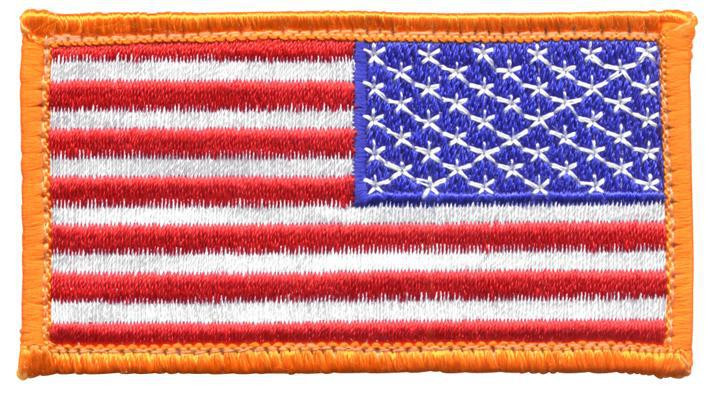
The tradition of having the flag reversed on the military uniform come from early Army history when both mounted cavalry and Infantry units would assign a standard bearer who would carry the Colors into battle. As the flag bearer charged forward, momentum caused the flag to stream back. Since the flag is mounted with the field of stars closest to the pole, that section stayed to the right, while the stripes flew to the left.
When the U.S. Flag is displayed on a moving object, the highest position of honor is the front, and not the rear; so the field of stars should be displayed toward the front. As a soldier moves forward, the stripes should appear to flow to the rear as if it were blowing in the breeze. If a flag were to not be reversed, it could appear that it is moving backward; appearing to be retreating.
In February 2004, Army Chief of Staff Gen. Peter Schoomaker approved the flag for continuous wear on the uniform, giving soldiers until Oct. 1, 2005 to get the reversed flag sewn on their uniforms. Prior to then, flags were only put on the uniform during deployments. One reason for the change was to represent our commitment to fight the war on terror and “serves as a vivid reminder that our nation is at war.” (SGM Walter Morales)
The flag is governed under Army Regulation 670-1, “Wear and Appearance of Army Uniforms and Insignia.” According to Army Regulation 670-1, Paragraph 28-18, “All soldiers throughout the Force, regardless of deployment status, will wear the full-color U.S. flag cloth replica on utility and organizational uniforms.” The regulation also states that, “The full-color U.S. flag cloth replica is worn so that the star field faces forward, or to the flag’s own right. When worn in this manner, the flag is facing to the observer’s right, and gives the effect of the flag flying in the breeze as the wearer moves forward. The appropriate replica for the right shoulder sleeve is identified as the reverse side flag.”