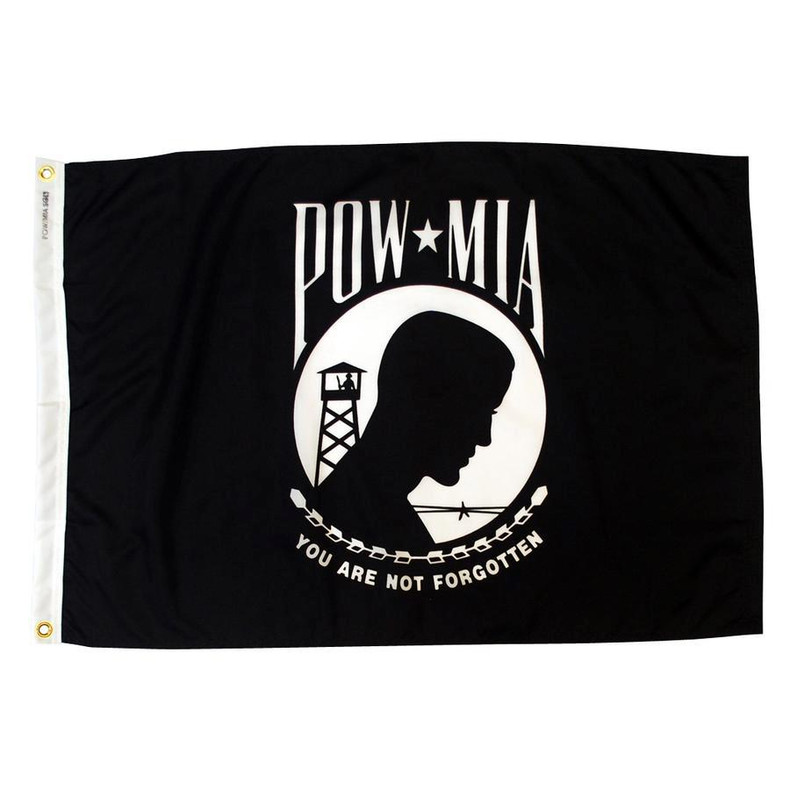
In 1971, Mary Hoff, the wife of a U.S. Navy pilot Lt. Cmdr. Michael Hoff who was listed as missing in action during the Vietnam War, developed the idea for a national flag that would remind every American of the U.S. service members that were missing or captured during the war. Mrs. Hoff was a member of the National League of American Prisoners and Missing in Southeast Asia.
Mrs. Hoff contacted Norman Rivkees, Vice-President of Annin & Company, in hopes that he would help create the flag. Rivkees then turned over the job of designing the flag to a graphic artist, Newton F. Heisley, who had served in World War II as a C-46 twin-engine transport pilot with the 433rd Troop Carrier Group.
The flag is a black and white flag with the emblem of the League in the center. The emblem is a white disk bearing a black silhouette of a bust of a man. Behind the silhouette is a watch tower with a guard holding a rifle; a strand of barbed wire to the front. Above the disk are the white letters POW and MIA with a single white 5-pointed star separating the letters. Below the disk is a black and white wreath above the white motto YOU ARE NOT FORGOTTEN.
Some alternate versions of the flag have also been produced. The POW/MIA is sometimes switched; sometimes the flag is switched from black and white to black and red, or perhaps red white and blue. In many flags, the guard is not shown to be carrying a rifle. The meaning still remains.
On August 10, 1990, Congress passed U.S. Public Law 101-355, designating the POW/MIA flag “The symbol of our Nation’s concern and commitment to resolving as fully as possible the fates of Americans still prisoner, missing and unaccounted for in Southeast Asia.”
Section 1082 of the 1998 Defense Authorization Act establishes a National POW/MIA Recognition Day which is observed on the third Friday in September.